Welcome to the PrecisionAg Lab@TUM
Since its founding in 2020, the TUM Precision Agriculture Lab has been committed to empower smart farming research, education, and practice.
Latest News

Latest Journal Papers
(2026).
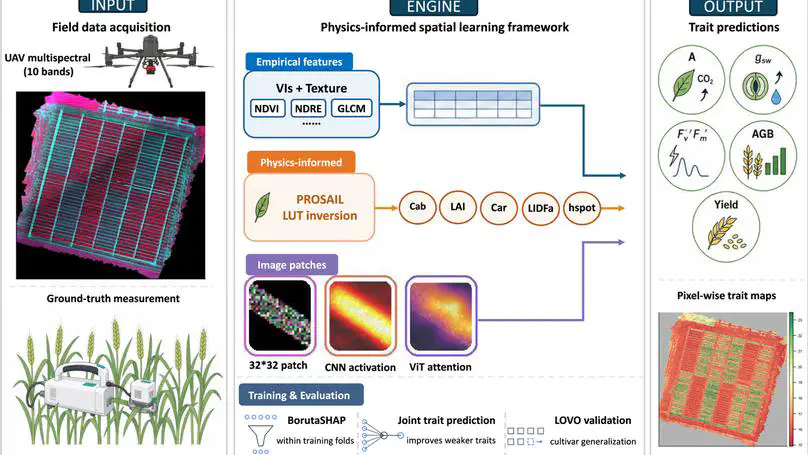
Physics-informed machine learning and Vision Transformer for predicting photosynthetic traits, biomass, and grain yield in winter wheat using UAV multispectral imagery.
European Journal of Agronomy.
(2026).
An Intelligent Data-Driven Framework for Optimizing Wheat Management toward High Yields with Reduced Nitrogen Inputs.
Computers and Electronics in Agriculture.
(2026).
Chlorophyll-Based Canopy Photosynthesis Model: Development and Global Synergy Analysis.
Remote Sensing of Environment.
(2026).
Phenotyping maize stay green traits via in situ leaf hyperspectral reflectance sensing.
Smart Agricultural Technology.
(2026).
A Transferable MMD-CWT Framework for Accurate Cross-Regional Prediction of Maize Leaf Nitrogen Using Hyperspectral Sensing.
European Journal of Agronomy.